Enjoy 20% off ALL digital guides (enter Code: OT)

Beyond the Diagnosis: Understanding Academic Accommodations through an OT Functional Performance Evaluations
This blog post goes into the occupational therapy, my OT evaluation process to ensure students receive recommended accommodations so they can focus on their occupation of being a student. Parents do not need to spend thousands on exhaustive psychoeducational re-evaluations that don't offer practical solutions. You need a clinical partner who understands how to bridge the gap between "diagnosis" and "access."
SCHOOL ACCOMMODATIONS
Dr. Fay Gersh, OTR/L, OTD, MBA
4/24/20268 min read
Introduction: The Battle for Academic Support
For many parents navigating the education system, securing academic accommodations for their children with ADHD, autism, or executive functioning challenges often feels like an uphill battle. Despite obtaining a formal diagnosis, these parents may find themselves confronting numerous emotional and practical obstacles that complicate the process of advocating for their child's needs. The initial diagnosis can serve as a double-edged sword; while it may bring clarity and validation to the struggles faced, it does not automatically pave the way for effective support within academic environments.
Parents frequently report experiencing significant friction points, even after obtaining the essential documentation that highlights their children's specific requirements. This could stem from a lack of understanding among school officials regarding individual diagnoses or a reluctance to implement tailored accommodations that deviate from traditional policies. The transition from diagnosis to actionable support involves navigating complex educational regulations, which can be daunting and disheartening.
Moreover, the emotional toll on parents should not be overlooked. They often feel an acute sense of urgency and responsibility to advocate consistently for their children, which can lead to feelings of frustration and helplessness when facing bureaucratic hurdles. Furthermore, the stigma associated with disabilities such as ADHD and autism may hinder open communication and collaboration between parents and educators, exacerbating the struggle for academic support.
This landscape of advocacy highlights a critical need for understanding the intersection of diagnosis and practical accommodations. By shedding light on these challenges, we can begin to explore effective strategies for navigating this complex system. Ensuring that children with diverse learning needs receive appropriate academic support is not merely an educational issue; it is a fundamental right that requires comprehensive attention and action from all stakeholders within the educational framework.
Understanding the Limitations of Standard Accommodations
In the educational landscape, traditional accommodations such as extended time on tests or access to quiet rooms are often implemented to support students with disabilities. While these measures are well-intentioned, they frequently fall short of addressing the complex challenges that students face. This disconnect is particularly evident when students experience specific functional barriers that are not adequately acknowledged by generalized support systems. For example, a student diagnosed with a learning disability may receive added time for assessments, but this does not necessarily equip them to navigate their unique difficulties in processing information.
Standard accommodations tend to mirror a one-size-fits-all approach, which fails to recognize the nuanced ways in which different students experience disabilities. Functioning deficits might stem from sensory processing issues, executive functioning challenges, or other barriers that impact a student’s ability to engage fully in the academic experience. As a result, even students granted additional time may still struggle due to underlying difficulties that extend beyond mere test-taking scenarios.
Moreover, focusing solely on a medical diagnosis without considering the practical implications in an academic setting may lead to oversight of vital needs. For instance, a student with anxiety may find that additional time does not alleviate their stress or help them gather their thoughts during high-pressure tests. Such examples underscore the necessity for a more individualized approach to accommodations.
Ultimately, employing tailored solutions that reflect each student’s unique functional performance is essential. This requires comprehensive evaluations that go beyond conventional methods, integrating insights into how various disabilities impact daily educational engagement. A thorough understanding of these limitations provides a foundation for developing more effective, personalized supports that genuinely respond to students’ needs.
The Role of Functional Performance Evaluations by an OT
Functional performance evaluations are a vital tool in better understanding the complexities of a student’s academic experience. These evaluations go beyond the scope of merely diagnosing learning disabilities or challenges; they aim to assess how a student interacts with their educational environment, factoring in their unique neurobiological makeup. By evaluating a student's functional capabilities, educators can develop tailored support systems that enhance learning outcomes.
At its core, a functional performance evaluation considers a range of elements, including cognitive abilities, emotional well-being, and social skills. The assessment process explores how these factors influence a student’s ability to manage academic tasks effectively. For instance, a student with attention difficulties may excel in subjects that spark their interest but struggle significantly in more traditional settings. Conversely, a student with processing delays may require extended time on tests, not due to a lack of knowledge, but rather due to their need for additional time to interpret and respond to information.
Moreover, these evaluations place emphasis on real-world applications, situating academic performance within the broader context of a student’s day-to-day life. This perspective helps in identifying not only what accommodations are necessary but also in understanding why these adjustments significantly impact a student's ability to thrive academically. Implementing findings from functional performance evaluations not only fosters a supportive educational framework but also promotes equity in academic opportunities, allowing each student to demonstrate their true potential.
The Occupational Therapy Practice Framework: A Clinical Approach
The Occupational Therapy Practice Framework (OTPF-4) serves as a vital tool in identifying barriers that students may encounter in their academic environment. This framework emphasizes the importance of understanding performance through the lens of function rather than solely relying on clinical diagnoses or labels. By doing so, it encourages practitioners to explore the factors affecting a student’s ability to engage meaningfully in their educational activities.
The OTPF-4 outlines key domains such as occupations, client factors, performance skills, and contexts that significantly influence a student's functional performance. These elements are essential for occupational therapists to consider when evaluating a student's strengths and weaknesses. For instance, by assessing performance skills—including motor skills, process skills, and social interaction skills—therapists can paint a comprehensive picture of a student's day-to-day functioning.
Moreover, through a contextual analysis, therapists can identify environmental factors, such as classroom layout or instructional methods, that may hinder a student’s performance. This detailed examination fosters an understanding of how different elements interact to affect academic success. By focusing on functional outcomes, the OTPF-4 facilitates the design of tailored interventions that address specific barriers, rather than merely accommodating diagnoses.
Utilizing the OTPF-4 enables a shift toward a more holistic view of student needs, promoting academic growth through targeted support. In this clinical approach, practitioners can identify the most effective strategies for each individual, leading to enhanced engagement and success in educational settings. This framework allows for a deeper understanding and ultimately assists in fostering an inclusive atmosphere where all students can thrive. Utilizing the Occupational Therapy Practice Framework is crucial in ensuring that interventions are rooted in functionality, paving the way for improved academic performance.
Building a Clinical Portfolio for Academic Access
Creating a robust clinical portfolio is essential for students seeking necessary academic accommodations. It serves as a testament to the individual’s needs, effectively translating results from functional performance evaluations into actionable recommendations. These evaluations are critical as they provide a comprehensive view of the student's abilities and challenges, which should be reflected in the clinical report.
A well-structured clinical report should include several key components: a detailed summary of functional performance evaluation outcomes, specific areas where the student requires support, and a clear rationale for each recommended accommodation. Each of these elements is vital for ensuring that legal provisions, such as Section 504 of the Rehabilitation Act and the Americans with Disabilities Act (ADA), are adhered to. These legal frameworks guarantee students with disabilities the right to receive the necessary tools and supports to succeed academically.
Moreover, the clinical report should utilize data-driven insights to advocate for the student's needs effectively. By incorporating standardized assessment results, observational data, and feedback from teachers or caregivers, the report can present a cohesive narrative of the student’s functional abilities and limitations. This comprehensive approach ensures that educational institutions are well-informed and better positioned to implement the recommended accommodations.
It is also paramount to keep the clinical portfolio updated. As the student progresses through their educational journey, regular reassessments and amendments to the report are necessary to accurately reflect any changes in functional performance. This ongoing documentation not only emphasizes the evolving nature of the student’s needs but also serves to strengthen their case for continued accommodations. By maintaining a meticulous clinical portfolio, the ongoing pursuit of academic accessibility and the support of legal protections remains viable and effective.
The transition from high school to higher education can be a significant challenge for students, particularly those who have received specialized support through K-12 educational systems. In primary and secondary education, students are often provided with a range of accommodations to meet their diverse learning needs, such as individualized education programs (IEPs) or 504 plans. However, upon entering college, these protections and accommodations do not automatically carry over, leaving many students feeling vulnerable and unprepared for the new academic landscape.
One critical aspect of this transition is that students must proactively establish their accommodations prior to graduation. Unlike high school, where educators have a legal obligation to identify and support students with disabilities, higher education institutions require those students to present appropriate legal documentation to justify their needs for specific accommodations. As such, students must engage with the functional performance evaluations to build a comprehensive understanding of their requirements and to ensure continuity in support.
To navigate this transition effectively, it is essential for students and their families to become informed about their rights and the processes involved in requesting accommodations in college settings. Engaging with disability services as early as possible can facilitate a smoother transition. Moreover, it allows students to articulate their academic needs based on their unique profiles discussed during functional performance evaluations. This proactive stance enables students to receive tailored support that promotes equitable access to educational opportunities within higher education institutions.
Ultimately, understanding the shift from K-12 protections to higher education requirements is crucial for students with disabilities. By prioritizing the establishment of necessary accommodations well before graduation, they can mitigate the challenges associated with this transformative period and set the foundation for successful academic experiences in their future endeavors.
Conclusion: Partnering for Success
In the pursuit of ensuring that students receive the academic accommodations they require, the collaboration between parents and clinicians is paramount. This partnership plays a crucial role in understanding the nuances of each student's needs beyond mere diagnoses. By engaging with clinical experts, parents can gain invaluable insights into how specific educational supports align with their child’s functional capabilities. Clinicians can provide the assessments necessary to understand how various factors such as learning disabilities, ADHD, or other challenges, influence a student’s academic performance.
The process of obtaining academic accommodations often involves navigating complex educational systems, which can be daunting for many families. Therefore, building a strong, communicative relationship with clinicians is essential. When parents and clinicians work together, they can advocate more effectively for the necessary supports that enhance a student’s educational experience. This collaborative approach ensures that academic accommodations are tailored to meet the individual needs of the student, thereby maximizing their potential for success.
Furthermore, when clinicians and parents partner closely, there is a greater likelihood of securing long-term support that extends beyond immediate academic needs. This ongoing engagement can empower students to thrive in their educational journeys, fostering a sense of confidence and independence as they advance. By understanding the implications of functional performance evaluations through a partnership lens, parents and clinicians can bridge the gap between diagnosis and academic advocacy, creating a beneficial network of support for students. Ultimately, this partnership is vital for positioning students on a path toward sustainable success in both their academic and future endeavors.
The OTD Difference: A Clinical Approach to Advocacy
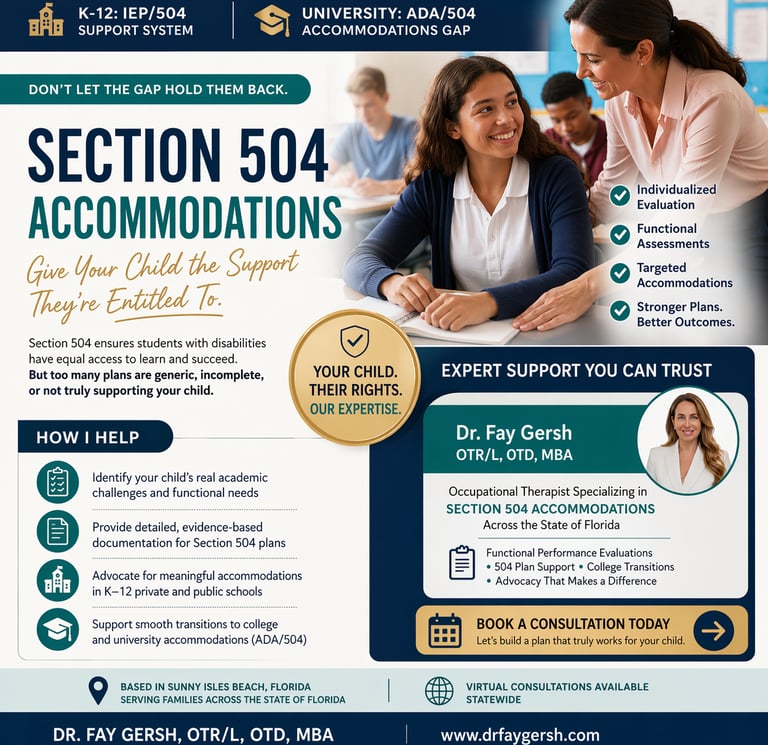
As a Doctor of Occupational Therapy (OTD), I provide Functional Performance Evaluations. This is a comprehensive, clinical audit of how your child’s neurobiology interacts with their academic environment.
My evaluation process includes:
Triangulated Data: A deep dive into medical history, teacher observations, parent reports, and student interviews.
Standardized Clinical Testing: Utilizing key school-based OT assessments to measure executive function, sensory processing, and cognitive endurance.
The Roadmap to Access: Translating that data into a professional clinical report that schools and universities are legally required to consider under Section 504 and the ADA.
Ready to Secure Your Child's Success
You don’t need to spend thousands on exhaustive psychoeducational re-evaluations that don't offer practical solutions. You need a clinical partner who understands how to bridge the gap between "diagnosis" and "access." That's where I come in. I am a licensed Florida practicing doctor of occupational therapy, and I am here to help your child thrive. My evaluations provide the objective data needed to secure mandateable, customized accommodations.
BOOK YOUR CONSULTATION TODAY Take the first step toward academic clarity. Click below to view my service tiers and schedule your initial consultation.